
671 matched watersheds and 8.4 million daily streamflow records.
Kenton Labs · Open data research
OpenFind
Find the signal. Test how far it travels. Keep the limits in view.
Three completed computational pilots · Evidence-led research
OpenFind builds reproducible analyses from public datasets. Each pilot starts with a bounded question, compares simple baselines with more detailed models, and tests whether an apparent result survives geographic or chronological separation.
01 / Hydrology
When low-flow patterns travel between watersheds
A public streamflow and watershed-attribute study examining low-flow buffering, geology, and prediction beyond familiar regions.
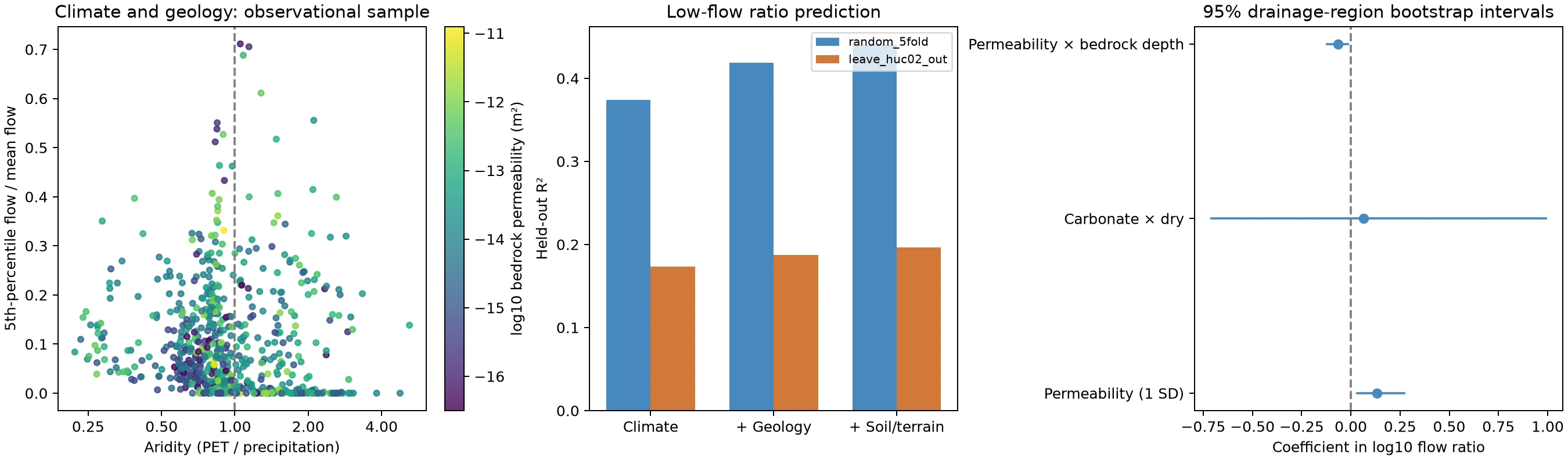
With all predictors, held-out-region R² was 0.196, compared with 0.440 under random folds.
A permeability–bedrock-depth interaction is an exploratory lead, not a causal or established discovery.
What the result supports
Random validation can overstate transfer to new drainage regions in this dataset. The next useful step is independent hydrogeology information or a geographically separate cohort.
Sources: CAMELS v2.0 · USGS daily streamflow
02 / Space weather
History matters in geomagnetic disturbance
A chronological analysis joining a published interplanetary coronal mass ejection catalog with NASA’s hourly solar-wind and geomagnetic records.
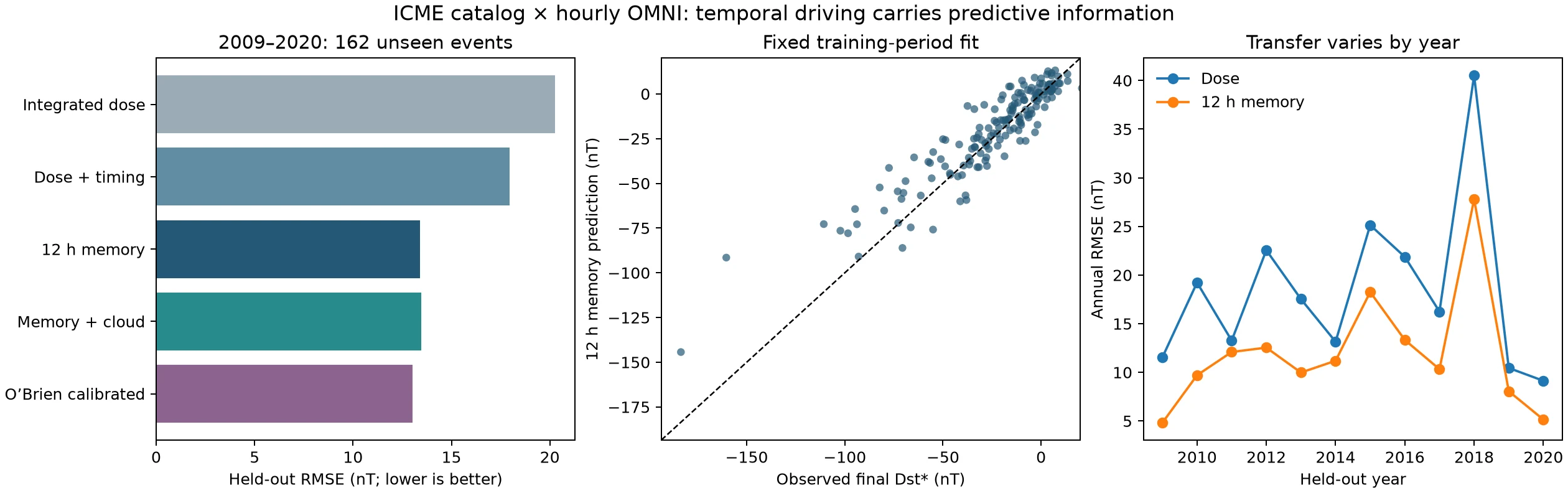
162 catalog events from 2009–2020, evaluated against a model fitted to earlier years.
A fixed 12-hour memory model reduced held-out RMSE by 33.9% versus integrated driving dose.
Retrospective conditional prediction; it uses measurements through the event and is not an advance forecast.
What the result supports
Temporal driving history improves this model comparison. The analysis does not establish a new physical mechanism; a residual timing lead did not transfer to later data.
Sources: Richardson/Cane ICME catalog · NASA OMNI data
03 / Public-program data
A benchmark audit, not a fraud detector
A reproducible audit of Medicare aggregate data matched to active federal exclusion records, asking whether public labels support a narrow screening benchmark.
About 1.8 million provider-year records across two measurement cohorts.
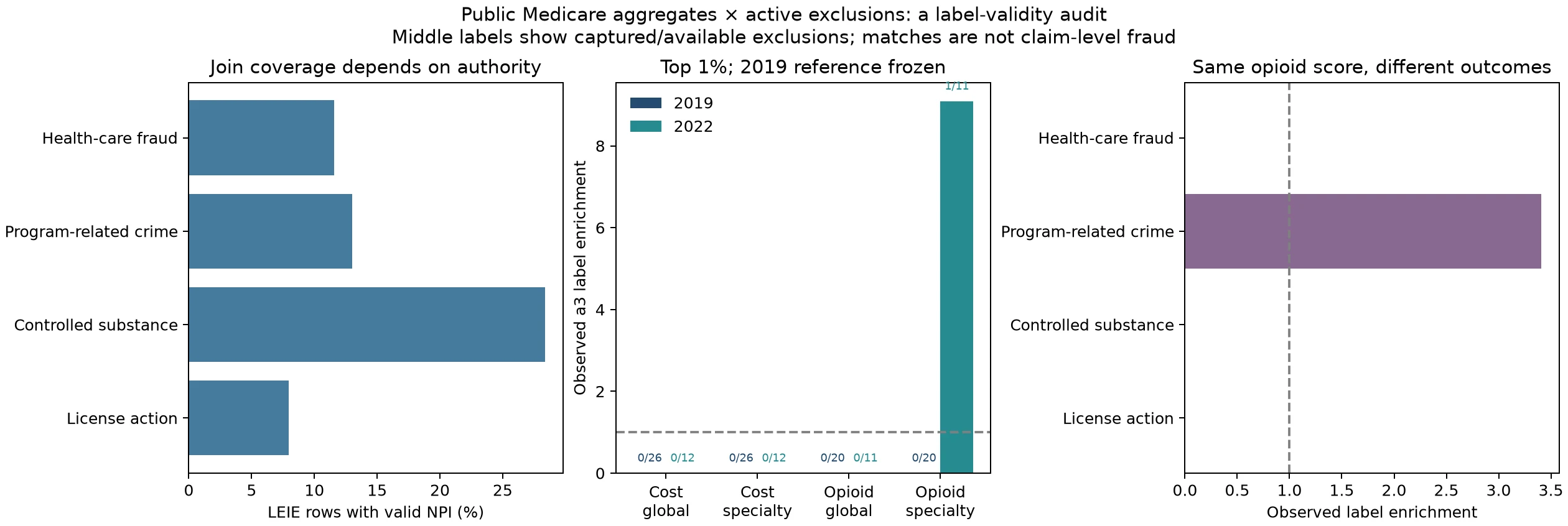
Only 12 eligible later matches for the specific health-care-fraud authority in the 2022 cohort.
Cost screens captured none of those 12; one adjusted opioid-score match among 11 available labels is too sparse to validate performance.
What the result supports
Label definitions, program coverage, and clinical specialty materially change the benchmark. The pilot identifies no new fraud case and validates no fraud detector.
Sources: CMS Part D prescriber data · HHS-OIG exclusion list
Research posture
OpenFind reports exploratory and negative results alongside the more promising patterns. The work does not infer causality from association, operational forecasting from retrospective prediction, or fraud from aggregate anomalies. Each pilot preserves source provenance and reproducible analysis records.